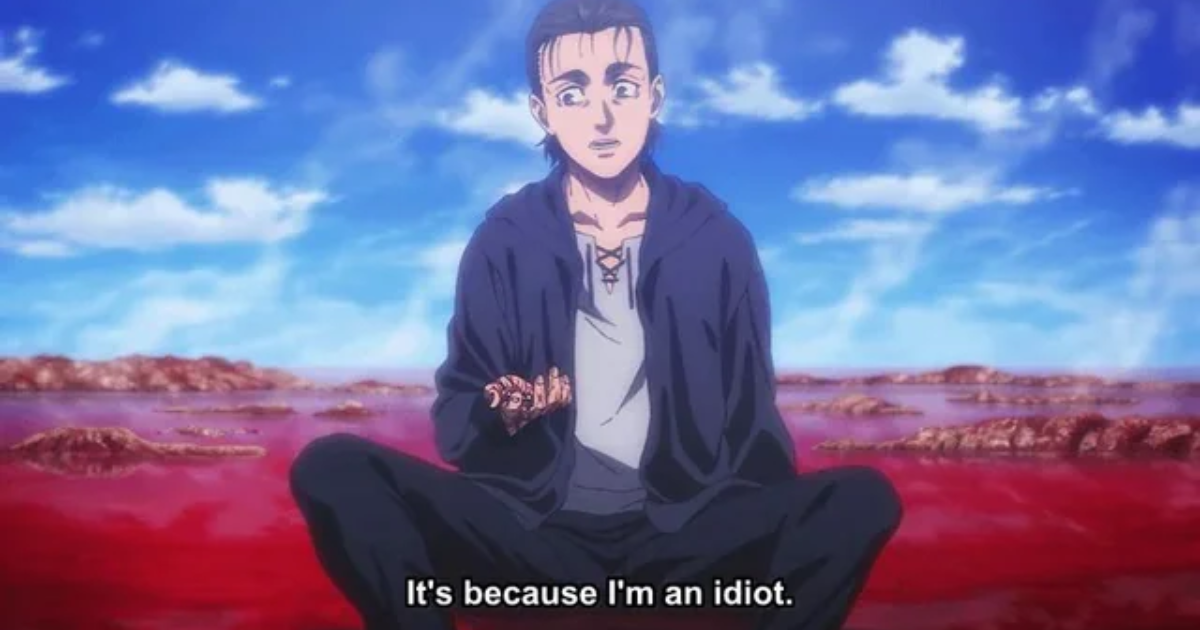
Spoiler scope: Full series, including the ending of Attack on Titan: The Final Chapters.
Attack on Titan is, on its surface, a shōnen action manga about a boy who watches a giant eat his mother and swears vengeance. By the time it ends, fourteen years and one hundred and thirty-nine chapters later, that same boy has become the fictional villain of one of the largest fictional genocides in modern manga. The transition does not feel like a betrayal. It feels like a re-read.
What Hajime Isayama does with Eren Yeager — and what MAPPA's adaptation, after the Wit Studio handover, sharpens — is a slow, deliberate reframing of a familiar character archetype. Eren begins as the protagonist a young reader is supposed to identify with. He ends as the figure those same readers, now adults, were supposed to start being afraid of. The shift happens across four specific pivots.
Pivot one: the Trost arc and the limits of righteous rage
For most of Season 1, Eren is a recognisable shōnen protagonist. His mother's death is the inciting trauma. His revenge is the stated motivation. The Trost arc, in which Eren first transforms into a Titan, is structured exactly like the early arcs of Naruto or One Piece: a hero discovers a secret power, uses it to save his friends, and is grudgingly accepted by the institution that previously distrusted him.
The first warning sign is small. In Episode 13 of Season 1 — Primal Desire — Eren plugs the hole in the wall by lifting an enormous boulder. He is described, in dialogue, as "the embodiment of human will." It's a triumphant scene. The score swells. The boulder thuds into place.
And then Levi appears, the credits roll, and the next arc immediately starts asking what exactly Eren's "will" actually wants. Not generally, but specifically. Does he want freedom? Does he want vengeance? Does he want, as he keeps saying, to "kill them all"? The show treats this question as an open one for the next sixty episodes.
Pivot two: the basement reveal
The end of Season 3 is the manga's structural midpoint and the series' single most important narrative event. Eren and the Survey Corps reach Grisha Yeager's basement in Shiganshina. They find his diaries. They learn that the world outside the walls has not been wiped out by Titans — it is functioning, industrialised, and at war with the people of Paradis. The Eldians — Eren's people — are the historical aggressors, descendants of the empire that conquered and brutalised much of the continent for two thousand years.
The reveal is told through Grisha's flashbacks, voiced by Hiroshi Tsuchida. It takes two full episodes. By the end of it, the show's central premise has inverted. Eren is not the underdog. He is the descendant of the historical bully. The horror that has hunted his city is not an evil older than time; it is a weapon developed by his ancestors. The walls were not built to keep monsters out; they were built to hide a war crime.
What Isayama does next is the move that defines the rest of the series. He gives Eren this information, lets him think about it for four years of in-universe time, and then takes him to Marley to look the other side of the war in the face.
Pivot three: the four-year gap
Season 4 opens with a four-year time skip. The show drops the audience in Marley, on the continent. The first episode does not feature Eren at all. It is told from the perspective of Reiner, Falco, Gabi and the Marleyan child soldiers — children growing up under the same propaganda that the Paradis kids were raised on, on the opposite side of the wall. The audience is asked, before they see Eren again, to recognise these new children as the same archetype Eren was in Season 1.
The pivot in this stretch is structural rather than emotional. The audience knows that Eren is the protagonist. The audience is now shown that the new Marleyan children are protagonists too, in their own narrative, against the horror of Eren. By the time the show finally cuts to Eren — sitting in a bombed-out Marleyan cellar, scarred and unrecognisable, having infiltrated enemy territory under a false name — he has already been recoded. He is no longer the kid screaming at the Titan. He is the figure the new kids have nightmares about.